
Your dream home starts taking shape long before tiles, paint, and furniture enter the plan. It starts with the steel order.
TMT bars for home construction sit inside footings, columns, beams, slabs, staircases, and roof projections, carrying the load your family will trust for decades. Many homeowners still reach the dealer counter with one question in mind, “What’s today’s rate?”
The rate helps with budgeting. TMT bars ensure the safety and durability of homes, with the tensile strength acting as the backbone of any construction project. The approved drawing, steel grade, bar diameter, standard length, piecewise count, and delivery stage decide whether the order fits the structure.
In this guide, you’ll follow the same path your steel purchase should take, from understanding the drawing and BBS, or Bar Bending Schedule, to checking grade, marking, delivery, and placing the final order. Always go for an authorized dealer or retailer while purchasing steel.
Start with the structural drawing, then ask for the quote

The structural drawing should guide the steel purchase.
A dealer can quote rates. A mason can suggest bar sizes from past work. A contractor can estimate quantities from experience. The drawing gives the actual reinforcement requirement for footings, columns, beams, slabs, staircases, balconies, and roof extensions.
For example, a roof slab may use one bar diameter and spacing, while columns may need another. Footings may need heavier reinforcement if the soil has lower bearing capacity or the house is planned for future floors. A balcony projection may also change the beam steel.
So, ask whether the steel requirement list came from the approved drawing. A lump-sum number such as “3 tonnes” or “5 tonnes” helps with budgeting, but it says little about what the site will receive.
A useful steel requirement list should show the diameter-wise split: 8 mm, 10 mm, 12 mm, 16 mm, 20 mm, or other sizes as per design.
Understand the BBS before you place the order
A Bar Bending Schedule (BBS) gives you a fair idea about every aspect of the steel bar. Whether you want to know about the size, shape, and length of the steel bars or estimate the quantity that should reach the construction site, BBS helps. When using steel sourced from a trusted primary steel manufacturer, BBS becomes even more effective in ensuring quality and accuracy. With BBS, you can relate to the engineer’s drawing with the quantity of steel that specifically reaches a construction site. It tells your contractor how much steel is needed for footing, columns, beams, slab, staircase, and the like. So, from estimating accurate steel requirements to cutting costs, reducing waste, and enabling faster site execution, a BBS offers ample benefits.
Check the grade before you compare prices
Steel grade affects strength, ductility, and long-term house construction performance.
Many homeowners compare steel through rate per tonne or rate per piece. Price gives one part of the answer. Grade gives another. A higher grade with ductility helps the structure take load and stress in a controlled way.
Fe 500D or Fe 550D is used where high strength and ductility are needed together in residential construction projects. The “D” indicates ductility. For a house, ductility matters because reinforcement should stretch under stress instead of failing suddenly during seismic tremors or heavy load-bearing instances. The structural engineer can be your best guide when deciding the TMT bar grades.
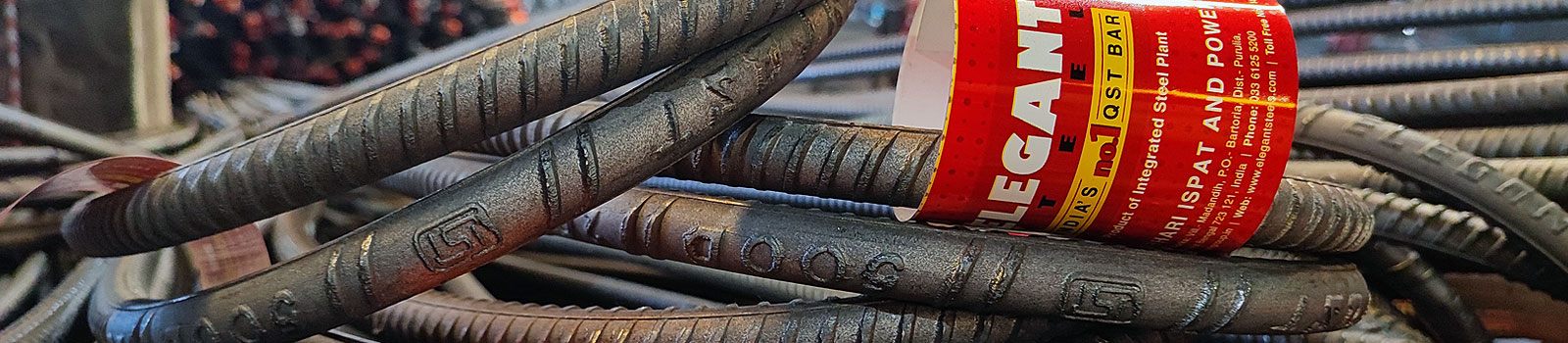
Most buyers use TMT as the common market term. ELEGANT Steel manufactures 550D QST Bars. QST means Quenched and Self-Tempered and for homeowners that connects to strength, ductility, bendability and weldability in house construction work.
So, when you compare steel bars for construction, ask about the grade first. Then ask how that grade fits your drawing, bar diameter requirement, and site conditions.
Check marking, standard, and source
A reliable steel purchase should be traceable.
Before unloading, check the bar marking, grade, diameter, standard length, invoice, and dealer source. If the bars are meant for RCC reinforcement, ask about IS 1786 alignment where applicable. IS 1786 covers high-strength deformed steel bars and wires for concrete reinforcement.
BIS-related manufacturing compliance also helps a homeowner separate a documented purchase from a vague one. Your steel should match the grade promised at the time of purchase.
This check needs to happen before the bars are cut, bent, tied, and placed inside shuttering. Once concrete covers the reinforcement, checking becomes harder and costlier.
Matching TMT bar diameter is essential
Each bar size has a specific role at site.
The engineer’s drawing decides the final use, but this table gives a homeowner-level view.
- 8 mm TMT bars: Commonly used for stirrups, links, slab distribution steel, and other light reinforcement work.
- 10 mm TMT bars: Typically used in slabs, stirrups, and secondary reinforcement where moderate strength is required.
- 12 mm TMT bars: Suitable for slabs, beams, and various structural elements as specified in the structural design.
- 16 mm TMT bars: Widely used for beams, columns, and footings in many residential construction projects due to their higher load-bearing capacity.
- 20 mm and above: Best suited for heavy load-bearing areas, larger columns, foundations, and projects designed for future floor expansion.
Treat this table as a guide. The drawing remains the final reference for bar diameter, spacing, bend shape, lap length, and cover.
A bar-size change may look small at the shop counter, but it can affect steel area, spacing, lap length, bending, and placement. Any such change should go back to the engineer.
Also Read: How Much TMT Do You Really Need for a 1000, 1500, or 2000 Sq Ft House?
Plan the purchase by pieces as well as weight
A requirement for steel order becomes easier to manage when it includes both total weight and piece count.
Steel bars are supplied in standard lengths. Your contractor may think in cutting lengths because bars require bending for footings, columns, beams, slabs, and stirrups. Planning TMT steel purchase decisions where you weigh in TMT bars by both pieces and weight, it enables in achieving greater control over procurement. While weight gives you a fair idea of the total quantity purchased, counting every TMT bar provides an easy way to keep a tab on deliveries and overall inventory. Your site team needs both views.
Ask for:
- Total quantity
- Diameter-wise quantity
- Piecewise count
- Standard length
- Stage-wise delivery requirement
- Cutting and wastage allowance
This helps during unloading steel and one can keep a count on pieces, check diameters, and match the supply with the purchase note.
Look at bendability, ductility, ribs, and weldability
A homeowner rarely tests steel in a lab, but a few quality points still deserve attention.
Bendability helps when bars are shaped for beams, columns, stirrups, hooks, and bends. Ductility helps the bar take stress with controlled stretching. Rib pattern helps the steel bond with concrete. Weldability matters where welding is allowed by the engineer or project requirement.
When people search for the best TMT bar in India, they’re usually trying to compare trust, safety, grade, and long-term durability. The better way to judge the purchase is to ask sharper questions.
What grade is the bar? Is the supply marked? Does the diameter match the drawing? Can the dealer provide the right size mix? Will delivery match the slab or footing schedule? Has the engineer checked the final bar list?
Those answers give a clearer buying decision than a brand name alone.
Plan delivery around the construction schedule
Steel should reach the site before casting pressure begins.
For a house, steel often comes stage-wise. Footing steel comes before foundation work. Column steel follows before vertical reinforcement starts. Beam and slab steel should arrive before shuttering and slab tying reach full speed.
A delay at this stage can hold up carpenters, bar benders, masons, and concrete work. During monsoon, storage adds another concern. Bars lying directly in mud or standing water can create handling issues, especially on lane-facing plots with limited movement space.
Ask your contractor which home construction stage is next, how much steel that stage needs, and how many days of lead time the dealer needs for delivery.
Watch for common buying mistakes
A rushed steel order can disturb cutting, bending, unloading, storage, and slab casting.
Watch for these mistakes:
- Buying only by the lowest rate
- Skipping grade and marking checks
- Ordering before confirming diameter-wise quantity
- Replacing one diameter with another before engineer approval
- Mixing grades before engineer approval
- Ignoring piecewise count
- Missing delivery timing before slab casting
- Storing bars directly in mud or water
- Ordering the full quantity at once on a site with limited storage
A cleaner purchase starts with the drawing, moves through the BBS or required steel, and ends with a delivery plan that matches the home construction schedule.
For homeowners, ELEGANT Steel 550D QST Bars fit into the quality discussion around grade, strength, ductility, bendability, weldability, and home construction suitability. These QST bars for construction are available in 6 mm, 8 mm, 10 mm, 12 mm, 16 mm, 20 mm, 25 mm, 28 mm, and 32 mm diameters, so the final order can follow the size mix given in the drawing.
The practical question has two parts: which steel should you buy, and what grade, diameter, piece count, and delivery stage your site needs. Choose an authorized dealer or retailer when purchasing steel. Make it a worthwhile investment, one that you will never regret in future.
If you’re planning steel for your home, our team can help you understand ELEGANT Steel 550D QST Bars, bar sizes, piecewise quantity, and delivery planning before construction work begins.

